Documentation Index

Fetch the complete documentation index at: https://usefulai.com/llms.txt

Use this file to discover all available pages before exploring further.

By Alex · Updated May 16, 2026 AI app builders promise to take a prompt and return a working, deployable application - real authentication, a database, a live URL. Your first decision: generated code you can take with you (Lovable, Bolt, Replit Agent, v0, Base44, Emergent), or a visual editor you’ll live inside long-term (Softr, Bubble)? We evaluated 16 tools across both paradigms and stress-tested the pricing models against real-user accounts.

Best AI App Builders

#ToolBest For
1LovablePolished full-stack web SaaS
2Bolt.newFramework flexibility and Expo mobile
3Replit AgentProduction infra from the same surface
4v0 (Vercel)Next.js teams on the Vercel stack
5Base44Easiest first-prompt to deployed app
6EmergentMaximum agent autonomy, large context
7SoftrBusiness portals and internal tools
8BubbleDeep no-code customization, long-term

1. Lovable: Best for polished full-stack web SaaS

Lovable generates a React + Supabase app from a prompt, ships it with auth and a database pre-wired, and as of April 2026 adds Paddle and Stripe payments first-class - meaning you can go from prompt to a working subscription business in one sitting. The output is consistently the cleanest React code in the AI-native subset, which is why the “prototype in Lovable, graduate to Cursor” pattern has become the standard recommendation on every relevant community. The trade-off: credits burn on iteration loops whether the AI’s fix succeeds or not, and the headline $25/month only covers 100 credits.

What We Like

Auth, database, and payments wired in by default. Supabase comes baked in - you don’t pick a backend. Paddle and Stripe payments landed as first-class features in April 2026, and the January 2026 enterprise wave added SAML 2.0 SSO, workspace provisioning, and a 20+ connector drop spanning Google Workspace, M365, BigQuery, Databricks, HubSpot, and Sentry MCP in a single release. If you’re building a web SaaS MVP, this is the fastest pre-wired stack in the category. Real React code you can take with you. Lovable exports cleanly to GitHub, and the React + Tailwind output is the one developers who don’t use Lovable still cite as the cleanest in the field. When you outgrow prompt-only iteration, the export path to Cursor or Claude Code actually works.

What We Don’t Like

Credits burn on iteration, not on outcomes. Your bill scales with how many times the AI retries your fix. Serious building will exhaust 100 monthly credits and need top-ups or a higher credit tier - the “every meaningful feature request just drained my subscription” complaint is common enough that it’s now a documented switching reason. Web-only - no native mobile output. Lovable generates responsive web. No React Native, no Expo, no App Store path. If your audience expects to download your app, use Bolt-via-Expo or Replit Agent.

Pricing

PlanPriceWhat’s Included
Free$05 daily credits (cap 30/mo), public projects, 5 lovable.app domains
Pro$25/mo100 monthly credits + 5 daily (cap 150/mo), custom domains, credit rollovers, unlimited users
Business$50/moAll Pro + SSO, team workspace, role-based access, security center
EnterpriseCustomVolume credits, SCIM, audit logs, dedicated support
Cloud + AI usage is metered separately on top of credits.

Platform Availability

Web, Mac, Windows (desktop app launched April 2026)

Who It’s For (and Who Should Skip It)

Best for non-technical founders shipping web SaaS, MVPs, and internal tools who want a clean code exit ramp. Skip it if you need native mobile (Bolt-via-Expo handles that better), if you want a visual editor as your long-term home (use Bubble or Softr), or if predictable flat pricing matters more than speed (Base44 or Softr are cleaner).

2. Bolt.new: Best for framework flexibility and Expo mobile

Bolt runs a full Node.js environment in the browser via WebContainers, which means you actually pick your stack - React, Vue, Svelte, Astro, Next.js, anything that runs in the container. That framework flexibility, plus real native mobile via Expo integration, makes Bolt the AI-native choice when Lovable’s React-only, web-only defaults don’t fit. The April 2026 update added real-time multiplayer collaboration, GitHub-org-level install, and role-based sharing, which closed Bolt’s main gap versus Lovable for teams. The headline weakness: Bolt requires a Chromium browser - Safari and Firefox users get a warning to switch.

What We Like

Framework flexibility via WebContainers. Lovable is React-only; v0 is Next.js-native. Bolt is the only AI-native tool that lets you build in whatever JavaScript framework your team already knows. If you have an existing stack preference, this matters a lot. Real native mobile via Expo. Among AI-native tools, only Bolt and Replit Agent have first-class Expo integration. You can build a real React Native app and ship it to the App Store and Google Play without leaving the Bolt surface. Best team workflow in the AI-native set. Real-time multiplayer collaboration with conflict avoidance, a Projects dashboard, role-based sharing (Viewer / Editor / Co-owner), and GitHub org install all landed in April 2026. If you’re a team of two or more, Bolt now beats Lovable’s team workspace on most dimensions.

What We Don’t Like

Default UI is less polished than Lovable’s. Bolt outputs are functional and clean but need more design iteration than Lovable’s shadcn-styled defaults. For stakeholder demos and investor-ready prototypes, expect a few extra rounds. The v1 Agent retirement creates migration friction. Existing v1 projects auto-switch to the new Claude Agent on August 3, 2026 - code style, behaviors, and assumptions may shift mid-project. Not relevant to new users, but material if you’re returning to a project you started months ago.

Pricing

PlanPriceWhat’s Included
Free$0300K daily tokens, 1M/mo total, hosting, unlimited databases
Pro$25/mo10M tokens/mo, no daily cap, custom domain, token rollover, AI image editing
Teams$30/member/moAll Pro + centralized billing, GitHub org, design system prompts
EnterpriseCustomSSO, audit logs, SLAs, dedicated AM
Token-based pricing (not credits) - bundles can be increased via dropdown.

Platform Availability

Web (Chromium browsers only: Chrome, Edge, Opera, Brave)

Who It’s For (and Who Should Skip It)

Best for builders with existing framework preferences, mobile-first founders who need Expo, teams that want real multiplayer, and anyone who values the open-source community fork (35K+ combined GitHub stars across bolt.new and bolt.diy) as insurance. Skip if you want the most polished default UI (Lovable is better), or if you need pre-wired auth and payments out of the box.

3. Replit Agent: Best for production infra from the same surface

Every other AI-native tool generates your app and then sends you somewhere else to deploy and scale it. Replit owns the full stack - build, host, scale, monitor, and roll back - all from the same surface. Agent 4, launched March 2026, is the headline: natural language to production-ready code with auth and database management included, plus an infinite canvas with parallel agents so you can explore multiple design directions simultaneously. The April 2026 release added Security Agent (full codebase review) and CVE Auto-Protect (automatic vulnerability patching), directly addressing the most persistent critique about AI-generated code quality. The headline warning: Replit’s Effort-Based Pricing is pay-as-you-go on top of your monthly plan, and surprise bills are the most-cited community complaint.

What We Like

Real production infrastructure on the same surface. Replit hosts your app, scales it, and monitors it in production - App Monitoring landed May 2026. You don’t assemble Supabase and Vercel; Replit owns the full stack. The only tool here that’s genuinely end-to-end. Multi-language + parallel agents. Python, Go, Ruby, Java - 30+ languages, while every other AI-native tool is JavaScript-only. On Core you get 2 parallel agents; on Pro, 10. Exploring three design directions simultaneously on the same infinite canvas is a genuinely different way to build.

What We Don’t Like

Effort-Based Pricing surprise bills. Your plan covers a fixed credit allowance; Replit charges pay-as-you-go on top for anything beyond it. Community reports of $607 in additional charges in a single session are the most-cited number in any Replit discussion. Spend controls exist but you have to set them up yourself. Walled-garden migration. You can export your code, but Replit’s auth, database, hosting, and rollback features are all tied to Replit’s infrastructure. Migrating out means rebuilding the infrastructure layer from scratch - meaningfully more friction than Lovable’s GitHub-export model.

Pricing

PlanPriceWhat’s Included
StarterFreeDaily agent credits, publish 1 project
Core$25/mo ($20/mo annual)$25 monthly credits, 5 collaborators, 2 parallel agents
Pro$100/mo ($95/mo annual)$100 monthly credits, 15 collaborators, 10 parallel agents, premium models, DB rollbacks
EnterpriseCustomSSO/SAML, single-tenant, VPC peering, dedicated support
Effort-Based Pricing adds pay-as-you-go charges on top of any plan.

Platform Availability

Web; Replit mobile app (iOS, Android) for building from your phone

Who It’s For (and Who Should Skip It)

Best for non-technical founders who want one tool that handles everything from build to scale, Python and non-JS builders who can’t use Lovable or Bolt, and teams that want parallel-agent exploration. Skip if budget sensitivity is high (use Lovable or Base44 instead) or if you need clean code portability (Lovable or Bolt export more freely).

4. v0 (Vercel): Best for Next.js teams on the Vercel stack

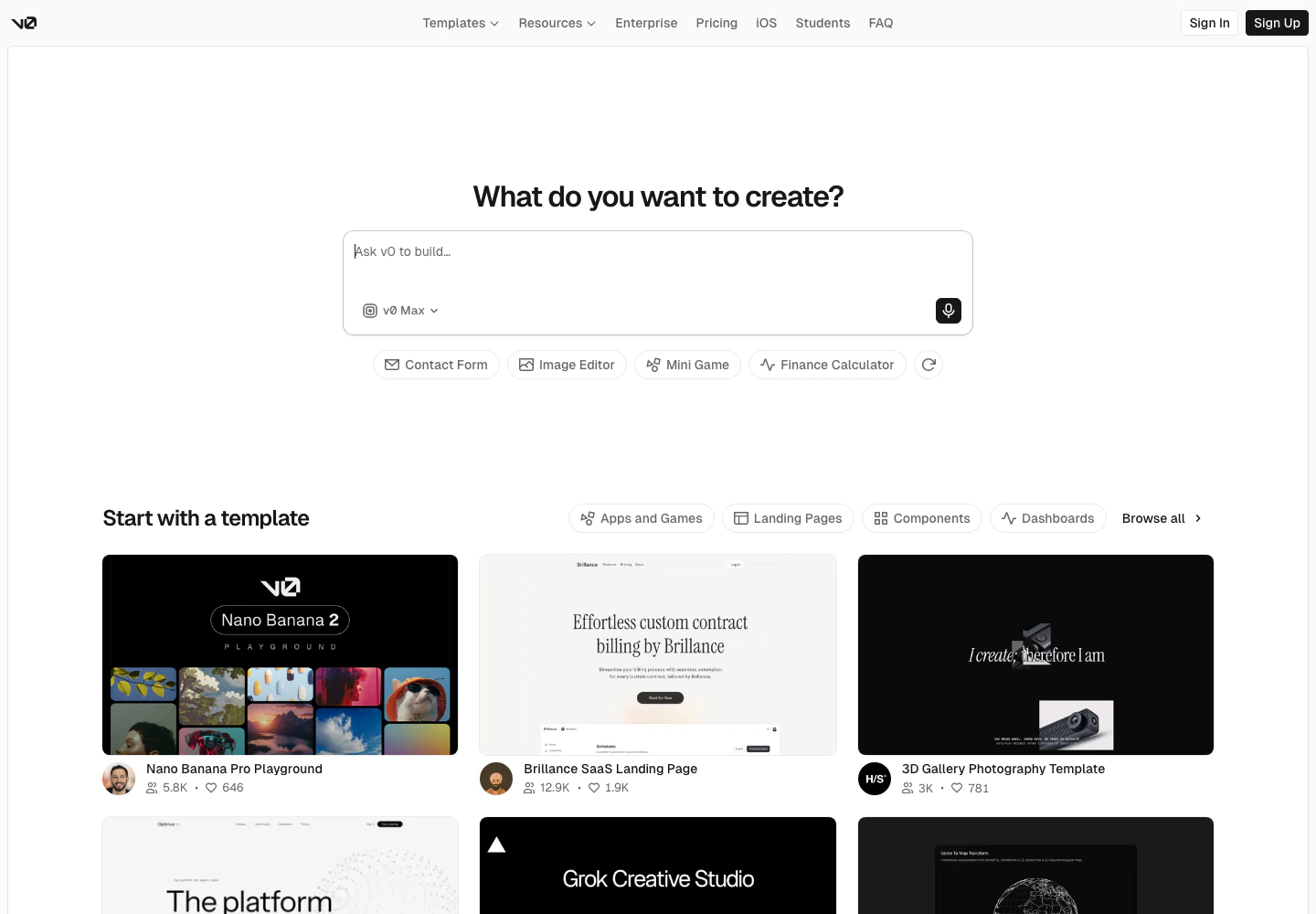
v0 AI app builder interface
v0 has meaningfully evolved past “the shadcn component generator.” The February 2026 relaunch added full Git support, a VS Code editor in the browser, secure AWS and Snowflake database integrations, and deployment protection for internal apps - repositioning v0 from vibe-coding novelty to production-bound Next.js builder. If you’re already on Vercel, v0 is the only tool here that’s truly first-class to your stack: GitHub sync, branching, PRs, one-click deploy, and the Vercel Marketplace for backends all work natively. The free tier is the most aggressive rate limit in the category - 7 messages per day - so realistic evaluation requires a paid plan from day one.

What We Like

Next.js-native generation that deploys to Vercel in one click. v0 produces real Next.js apps with server components and API routes, styled with shadcn/ui and Tailwind by default. No other tool integrates this cleanly into the Vercel ecosystem. Design Mode for non-code edits. When the AI gets a component 90% right and you want to nudge it visually, Design Mode lets you adjust without re-prompting. Combined with the in-browser VS Code editor from the February 2026 update, you can move between chat, visual edits, and direct code in one interface.

What We Don’t Like

Tightest ecosystem lock-in of any tool here. Lovable and Bolt export to GitHub and run anywhere. v0’s value collapses outside Vercel’s ecosystem - Marketplace dependencies, the deploy chain, and database connections all unwind if you leave. Irrelevant if Vercel is your long-term home; material if it isn’t. Free tier is unusable for real evaluation. v0 free gets $5 of credits and a 7-message-per-day cap. Bolt free gets 300K tokens per day. You cannot meaningfully try v0 without paying $30/user/month from day one.

Pricing

PlanPriceWhat’s Included
Free$0$5 credits, 7 messages/day, Vercel deploy, GitHub sync
Team$30/user/mo$30 monthly + $2 daily login credits, collaboration, centralized billing
Business$100/user/moAll Team + training opt-out by default, SAML SSO
EnterpriseCustomData never used for training, RBAC, priority access, SLAs
Model pricing ranges from v0 Mini ($1/$5 per 1M tokens in/out) to v0 Max Fast ($30/$150) - heavy use scales with model choice.

Platform Availability

Web

Who It’s For (and Who Should Skip It)

Best for Next.js teams already on Vercel, design teams shipping React components, and builders who want per-token cost control as a feature. Skip if you need framework flexibility (Bolt is better), if you don’t want Vercel lock-in (Lovable or Bolt are more portable), or if mobile is your goal.

5. Base44: Best for easiest first-prompt to deployed app

Base44 wins on first-prompt simplicity: no Supabase decision, no Vercel decision, no framework choice. You type a prompt, and Base44 returns a full-stack app with auth, database, hosting, and payments bundled. The five-tier annual pricing (Free -> Starter $16 -> Builder $40 -> Pro $80 -> Elite $160) is predictably capped per month in a way the credit-based competitors aren’t. The catch is the largest lock-in in the AI-native set: your backend cannot be exported. If your app succeeds, you stay on Base44 forever or rebuild from scratch. For beginners building their first SaaS or internal tool, this trade-off is probably fine. For anything production-bound that might scale, it matters enormously.

What We Like

Easiest first-prompt experience in the category. No backend decision, no framework decision, no deployment setup. For someone who has never built an app, this is the fastest path to a working URL someone else can visit. Measurably simpler than Lovable or Bolt on the first session. Predictable flat pricing. Five tiers with fixed message and integration credit caps - no token meter, no effort-based surprises. You know your maximum bill for the month before you open the editor (though the two-bucket credit system, message credits and integration credits, can still catch you off-guard if your app is integration-heavy).

What We Don’t Like

Backend cannot be exported - ever. Frontend code is editable in-app; backend is permanently locked to Base44. If you grow past Base44’s ceiling, the only option is a full rebuild. Every other AI-native tool here exports real code. This is the largest single risk in choosing Base44 and the reason most experienced reviewers stop recommending it for production-bound projects. “Fix one breaks many” cascades. The most repeated complaint in Base44’s own community: a small change request ripples unpredictably across unrelated parts of the app, and rollback doesn’t always cleanly undo the cascade. The workaround (freeze pages before making changes) is something you have to discover yourself.

Pricing

PlanPrice (annual)What’s Included
Free$025 message credits, 100 integration credits/mo
Starter$16/mo100 message, 2,000 integration credits, unlimited apps, code edits
Builder$40/mo250 message, 10,000 integration credits, custom domain, GitHub
Pro$80/mo500 message, 20,000 integration credits, early beta access
Elite$160/mo1,200 message, 50,000 integration credits, premium support
Prices are annual billing; annual saves 20%.

Platform Availability

Web

Who It’s For (and Who Should Skip It)

Best for absolute beginners, operators building internal tools, and founders prototyping simple SaaS where backend lock-in is acceptable. Skip if you might ever need to take your backend somewhere else (use Lovable or Bolt), or if your app needs complex business logic that might hit Base44’s ceiling sooner than you expect.

6. Emergent: Best for maximum agent autonomy, large context

Emergent is the most differentiated product on capability in the AI-native subset: a 1M context window on Pro, a multi-agent architecture that handles architecture, coding, testing, deployment, and editing with separate agents, and Fork + Rollback features that work like Ctrl+Z for AI builds. The first-month experience for an experienced prompt writer is genuinely surprising - the agent keeps context across long sessions and self-debugs in ways competitors can’t match. The problem is well-documented: credits burn on the AI’s own retries and bug-fix loops, customer support is widely cited as absent, and the UI output defaults to “functional but generic”. The experience is bimodal - either transformative or frustrating, depending entirely on whether you actively budget your credit spend.

What We Like

1M context window keeps complex projects coherent. The agent remembers architectural decisions, multi-step instructions, and earlier choices across long sessions without re-explaining. For complex apps with relational data, custom auth flows, and multiple integrations, this is the single biggest practical advantage in the category on Pro. Multi-agent architecture that actually decomposes the build. Separate agents handle architecture, coding, testing, and deployment. It generates a plan, asks clarifying questions before building, and self-debugs rather than asking you. The closest analogue is Replit Agent 4, but Emergent’s multi-agent decomposition is more explicit. Fork + Rollback for experimentation safety. Fork duplicates your project instantly; Rollback is a clean undo for any AI-driven change. These features change how willing you are to let the agent take risks - the first month feels materially less stressful.

What We Don’t Like

The credit system is widely flagged as a “trap.” Credits burn on the AI’s retries and bug-fix loops - you pay for the agent failing, not just succeeding. Multiple independent reviews describe it as the platform’s central flaw, and credit exhaustion before end-of-month is the most common first-month experience. If you don’t monitor spend explicitly, you’ll be surprised. UI ceiling is “functional byproduct.” Emergent treats UI as output secondary to a working app. Lovable and v0 both ship more polished default UI from the same prompt. Since extra UI iteration uses the same credit pool, the two weaknesses compound.

Pricing

PlanPriceWhat’s Included
Free$010 credits/mo, core features, web + mobile builds
Standard$20/mo (annual)100 credits/mo, private project hosting, GitHub integration
Pro$200/mo (annual)750 credits/mo, 1M context window, ultra thinking, custom AI agents
EnterpriseCustom-
Monthly pricing is not published; “Save $36/$396” vs annual implies monthly pricing is significantly higher.

Platform Availability

Web

Who It’s For (and Who Should Skip It)

Best for experienced prompt writers who want maximum agent autonomy, builders with complex multi-step logic that benefits from the 1M context window, and anyone who will explicitly budget credit spend from day one. Skip if you’re cost-sensitive (the credit system is the loudest complaint in the category - Lovable or Base44 are more predictable), or if you need solid customer support when stuck.

7. Softr: Best for business portals and internal tools

Softr’s March 2026 AI Co-Builder launch was the most consequential repositioning in the no-code subset. The framing is sharp: vibe coding asks you to keep prompting until something works; Softr’s Co-Builder aims to produce a functioning app on the first shot by defining the database, UI, permissions, and business logic all at once before generating a single page. For business apps - client portals, CRMs, internal tools, operational systems - this is meaningfully better than the AI-native “keep iterating and hope” loop. Softr also has the broadest native data-source integration in the category: Airtable, Google Sheets, HubSpot, Stripe, QuickBooks, Intercom, and 100+ sources all first-party. The catch, as with all no-code platforms: there is no real code export, ever.

What We Like

AI Co-Builder composes a full business app in one pass - including permissions. Database, UI, navigation, and user-access rules are all defined before a single page is generated. With Lovable or Replit you wire permissions after the app exists; Softr defines them upfront. For client portals and internal tools where role-based access is the entire point, this is the practical differentiator. Best-in-class native data-source integration. You connect a first-party data source and Softr builds the app on top - no plugin marketplace assembly required. If your data already lives in Airtable or Google Sheets, this is the easiest path to “now there’s an app on top of my spreadsheet.”

What We Don’t Like

No real code export - you’re committing to Softr long-term. Softr’s output is configuration inside the platform, not portable code. If you decide to leave, you rebuild from scratch. Unlike Lovable or Bolt where GitHub is the exit ramp, there is no exit ramp here. Per-app-user pricing ramps at scale. Each tier includes a capped app-user count (10 Free, 20 Basic, 100 Professional, 500 Business) with per-user overage above that. Fine for stable internal-tool headcounts; potentially expensive for consumer-facing apps with growth.

Pricing

PlanPriceApp UsersWhat’s Included
Free$010Custom domain, unlimited apps, 5 AI credits/mo
Basic$49/mo2010 AI credits/mo
Professional$139/mo10050 AI credits/mo, 3 custom user groups
Business$269/mo500100 AI credits/mo, unlimited user groups
EnterpriseCustomCustomSSO, SOC 2, audit logging
Annual billing saves 2 months.

Platform Availability

Web, Softr Mobile Apps

Who It’s For (and Who Should Skip It)

Best for B2B operators, agencies, consultants, and internal-tools builders who want database + permissions + UI wired together and are happy to live inside Softr’s visual editor long-term. Skip if portability matters (there is no code export), if you need a consumer-facing polished SaaS with design that stands out (Lovable is better), or if real native mobile is the goal (Adalo or FlutterFlow are stronger).

8. Bubble: Best for deep no-code customization, long-term

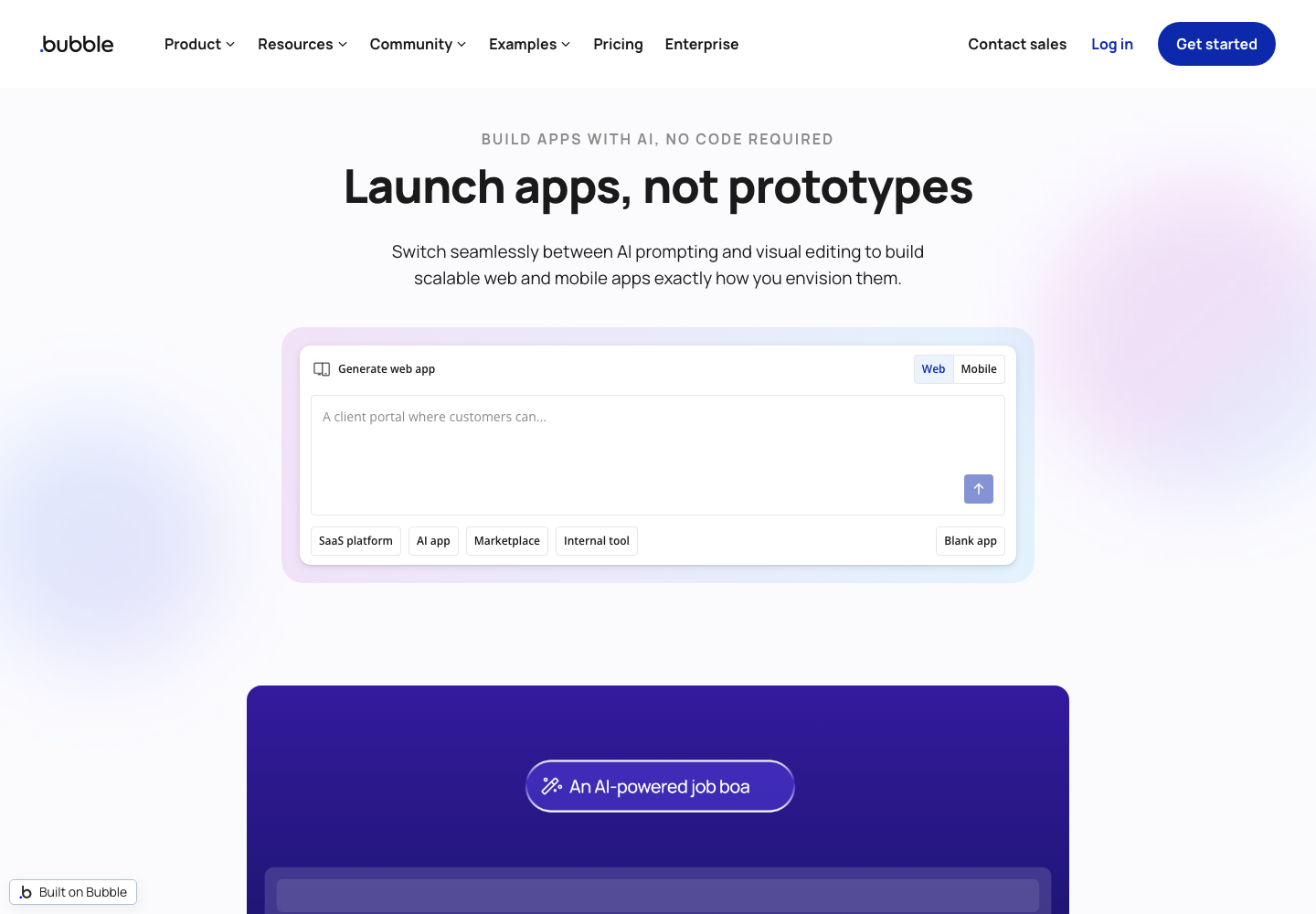
Bubble AI app builder interface
Bubble is the most mature no-code platform in this list, and the AI App Generator (5-7 minutes from prompt to MVP) and AI Agent (launched October 2025, with undo/redo and improved error handling added in May 2026) are additive to an already deep visual editor. With 8,000+ plugins, 5 million+ builders, and the largest no-code community in the category, Bubble is the safest long-term home for genuinely complex apps. Native mobile is in beta (iOS and Android via React Native, with guided App Store and Google Play submission), though the BETA label has been active for nearly a year and missing features like in-app payments are still on the roadmap. Workload Unit overages are the central pricing risk - apps with real traffic can hit WU walls that require add-on packs.

What We Like

Deepest customization in the category, full stop. Bubble can model what other no-code platforms can’t - complex relational data, multi-tenant architectures, marketplace logic, custom workflows, role-based permissions at scale. If your app is genuinely complex, Bubble is the only no-code option that won’t hit a ceiling. AI App Generator + AI Agent layered onto the visual editor. You can go from prompt to MVP in 5-7 minutes via the AI App Generator, then maintain and extend it using the AI Agent co-pilot inside the editor - suggesting workflows, generating database structures, creating test data, debugging. The May 2026 release added undo/redo to the Agent, a meaningful quality-of-life improvement. You can use AI when you want and pure visual editing when you don’t.

What We Don’t Like

Workload Unit overages are the central pricing risk. Bubble meters everything by Workload Units, and apps with real traffic hit WU ceilings and need add-on packs. Unlike Softr’s per-user flat pricing or Adalo’s “no usage charges,” your Bubble bill scales with how much your app does - which is harder to predict than user count. Weeks-to-months learning curve for non-developers. Bubble is the deepest no-code editor, and that depth costs real time. Most non-technical builders report 1-3 months before they’re shipping their first real project. Lovable, Bolt, and Base44 get you to a working URL in an afternoon. If “ship this weekend” is the goal, this is not the tool.

Pricing

PlanPrice (annual)WorkloadMobile Builds/moWhat’s Included
Free$050K WU/mo-1 editor, 6hr server logs
Starter$59/mo175K WU/mo51 editor, 3 live versions
Growth$209/mo250K WU/mo102 editors, 5 live versions
Team$549/mo500K WU/mo205 editors, 8 live versions
EnterpriseCustomCustomCustom-
Web + mobile builders are now bundled in all plans.

Platform Availability

Web; native mobile in BETA (iOS and Android)

Who It’s For (and Who Should Skip It)

Best for builders willing to invest weeks learning the platform, B2B SaaS founders with genuinely complex business logic, and agencies who want the deepest visual editor for long-term client work. Skip if you want to ship this weekend (use Lovable or Base44), if you need GA native mobile (Adalo or FlutterFlow are stable), or if you want predictable per-user pricing at scale (Softr is cleaner).

Selection Guide

Your first decision is paradigm, not brand. If you want real code you can take with you, choose from the top six. If you want a visual editor as your long-term home, go to Softr or Bubble.
  • If you want a polished full-stack web SaaS with payments wired in -> Lovable
  • If you need framework flexibility (Vue, Svelte, Astro) or real Expo mobile -> Bolt.new
  • If you need production hosting and DevOps from the same surface, or you’re building in Python -> Replit Agent
  • If you’re already on Vercel and building Next.js -> v0
  • If you’re a beginner and want the simplest possible first prompt to working URL -> Base44
  • If you need a 1M context window for complex multi-step apps and will budget credits actively -> Emergent
  • If you’re building client portals, internal tools, or business apps with real permissions -> Softr
  • If you want the deepest no-code customization and will invest in learning the platform -> Bubble

How We Evaluated

We evaluated 16 tools and selected 8 for this guide. We don’t use affiliate links, accept sponsorships, or take any form of payment from tool makers. Our recommendations are based entirely on our research and testing.

Selection Criteria

Output quality. Does the generated app actually work? Does auth wire correctly? Does the database schema make sense? We tested each tool with the same three prompts: a client portal, an inventory tracker, and a subscription SaaS. Pricing model honesty. We stress-tested what a realistic month of iteration actually costs - not the headline price. Effort-based, credit-based, and token-based models all get stress-tested against a heavy-iteration scenario. Code portability. For AI-native tools, we verified whether the generated code is actually exportable and usable by a developer or coding agent downstream. Platform and mobile output. We verified every mobile claim against vendor documentation rather than marketing copy - “mobile” means different things across tools.

Tools We Left Out (and Why)

Other Tools Worth Considering

  • Adalo - Best native mobile option in the no-code set. True iOS and Android compilation (IPA + APK) from a single visual canvas, flat pricing with no usage charges. Worth it if native mobile is your primary need and you prefer a visual editor. “Ada” launched March 2026 adds a natural-language build mode.
  • FlutterFlow - Flutter-native mobile with real Dart code export (from Basic plan). One-click App Store and Google Play deployment. The right choice for teams that need real cross-platform mobile with a code-ownership path.
  • Glide - Spreadsheet-driven internal tools and dashboards on top of Google Sheets, Airtable, or BigTables (up to 10M rows). Note: PWA output only - no native app store path.
  • Figma Make - Prompt-to-interactive-prototype inside Figma. The right tool if you want to validate a UI before building a real app. The output lives in Figma, not as a deployable.
  • Retool - Enterprise internal tools on existing databases. New AI App Generation in 2026. Differentiated user pricing (builder / internal user / external user). The enterprise standard for internal tools that need to connect to existing data sources.
  • Airtable Omni - AI-native Airtable for ops and data teams building app interfaces on top of their existing Airtable data. Not a standalone app builder - the output runs inside Airtable’s platform.
  • Magic Patterns - Design-to-code prototyping with multiplayer canvas, exports clean React + Tailwind. Worth it if you want UI components, not a full deployed app.
  • Dyad - Open-source, local-first, BYO-model app builder. 20K GitHub stars, 1M+ downloads. Free with your own API key. The right choice if you want no vendor dependency and full local control.

Adjacent Categories

  • AI coding agents (Cursor, Claude Code, Windsurf) - If you can already steer code, have hit the wall of prompt-only iteration, or want an IDE workflow, these are the natural graduation path from any AI-native tool. These are not app builders - they’re AI-assisted development environments for people who write or read code.
  • AI website builders (Wix AI, Webflow AI, Framer AI) - If you’re building a marketing site, portfolio, or content site - not an app with auth, a database, and user accounts - these are the right tools. They’re better at visual fidelity and SEO than any tool in this guide; they’re not designed for transactional functionality.
  • AI design/UI generators (Uizard, Galileo AI, Visily) - If you need a design or mockup of an app, not a deployable app, these are faster and cheaper. They produce editable UI in Figma or React; they don’t handle backend, auth, or deployment.

What You Need to Know Before Using AI App Builders

Your Code and Data Security

Every AI-native tool here generates code with potential security gaps - and the responsibility to review it sits with you. In March 2026, a Supabase misconfiguration in a Lovable-built app exposed data from thousands of users. Lovable’s platform wasn’t insecure; the generated configuration was. Before you ship any AI-generated app to real users, audit the access controls in your database, verify your authentication settings, and consider running the code through a security scanner. Tools like Replit now include a Security Agent and CVE Auto-Protect (launched April 2026) that automatically review and patch - but no tool does this perfectly.

App Store Publishing Risk

Apple removed Replit (and Vibecode, which is no longer available) from the App Store in March 2026 under Guideline 2.5.2, which prohibits apps that download and execute code not reviewed by Apple. Replit resolved the dispute and released an update in May 2026, but the underlying policy risk applies to any AI-codegen-to-mobile pipeline. If you’re planning to ship a mobile app built with AI tooling, verify the current App Store submission path for your chosen tool before committing - and have a backup plan.

Platform Lock-In and Data Portability

No-code tools (Softr, Bubble, Glide, Adalo) and one AI-native tool (Base44) have no real code export. Your app lives inside the platform forever; if you leave, you rebuild from scratch. For AI-native tools with real code export (Lovable, Bolt, Replit Agent, v0), verify the export actually works end-to-end before committing to a platform for a production app - the database and auth layer often have additional dependencies on the platform’s own infrastructure even when the frontend code exports cleanly.

Frequently Asked Questions

AI-native tools (Lovable, Bolt, Replit Agent, v0, Base44, Emergent) generate real code you can export and take with you. No-code tools with AI (Softr, Bubble) use AI to generate configuration inside a visual editor - the output is not portable. The prompt experience is similar; everything downstream - maintenance, portability, and pricing - is different.
Real native mobile (App Store + Google Play) is available through Bolt and Replit Agent via Expo (React Native), Bubble via React Native (still BETA as of May 2026), and Adalo and FlutterFlow (both GA native mobile, listed under Other Tools Worth Considering). Lovable and v0 are web-only. If native mobile is the goal, route to Bolt-via-Expo or Replit Agent on the AI-native side, or Adalo/FlutterFlow on the no-code side.
For no-code tools (Softr, Bubble), your app stops functioning if you cancel - there’s no code to take with you. For AI-native tools (Lovable, Bolt, Replit Agent, v0), you keep the generated code via GitHub export, but you lose the platform’s hosting and any platform-specific services (auth, database connections) that are managed by the tool. Base44 is the exception: the backend cannot be exported even on a paid plan.
They can be, but AI-generated code requires a security review before you ship to real users. Pay particular attention to database access controls, authentication configuration, and any third-party API credentials in your app. Some tools now include automated security review (Replit’s Security Agent + CVE Auto-Protect, Lovable’s security scanning) - use them. Don’t skip this step.
AI-native tools with code export (Lovable, Bolt, Replit, v0) make this more feasible - export to GitHub and import into a coding agent like Cursor or Claude Code. No-code tools (Softr, Bubble) and Base44 effectively make this a full rebuild. Plan your tool choice before you start building anything you plan to keep long-term.

We update this guide regularly as new tools launch and existing ones evolve. If you’re still unsure, Lovable is the safest starting point for most non-technical founders building web software. Questions or suggestions? Let us know.