We evaluated more than 20 AI chatbots, comparing ChatGPT, Gemini, Claude, and more on output quality, workflow fit, pricing, and trust.
Updated June 1, 2026
AI chatbots promise one general-purpose assistant for writing, research, coding, and everyday questions. The catch: the best one depends on your workflow, since ChatGPT, Gemini, and Claude each lose to a specialist for specific jobs. We evaluated more than 20 options and selected seven leading picks.
ChatGPT is still the chatbot that does the most things well without making you choose. You can write, generate images, work with files, run research, build with Codex, and connect apps like Notion or Linear without leaving one tab. If you don’t have a specialized workflow yet, it’s the easiest place to start, and the one with the most tutorials and team familiarity behind it.
Platforms Pricing: FreeIndividual $8–$100+/mo Teams $20/user/mo
It still covers the most ground in one product - drafting, files, images, research, spreadsheets, Codex, and connectors all in one place.
It’s the easiest chatbot to standardize on - more tutorials, prompt examples, and team familiarity than any alternative, so adoption friction is lower.
It’s not locked to Google or Microsoft - a good pick if you don’t want your assistant tied to a productivity suite you may leave later.
It can feel generic once you know your workflow - Claude is more thoughtful for serious writing, Gemini sharper for research and visuals; ChatGPT wins on breadth, not lanes.
Choose ChatGPT if you want one capable assistant for general work and don’t yet have a specialized lane. Skip it if your day runs through Microsoft 365 (Copilot), Google apps (Gemini), or serious writing and coding (Claude).
Gemini is the chatbot to choose if you already live inside Google. It pulls context from Gmail, Drive, Docs, Chrome, Search, and YouTube in ways no other assistant can match, and its image and video work consistently outperforms ChatGPT and Claude.
Google context is the real differentiator - Gmail, Drive, Docs, Chrome, Search, YouTube, and NotebookLM feed Gemini in ways no other assistant matches.
Image and video work is the reason to test it - if editing, generation, or multimodal input matters, Gemini’s advantage is most visible here.
Claude still wins on serious writing and coding - if long documents or code is your daily work, test Claude before committing; the gap is real.
Choose Gemini if you live inside Google, care about image and video work, or want research that pulls from your Drive. Skip it if you want Claude’s writing depth - ChatGPT is the safer neutral pick outside Google’s ecosystem.
Claude is the chatbot that feels like a careful collaborator rather than a generic answer machine. You notice it most when drafting long documents, editing critical writing, working through complex code, or shaping arguments where nuance matters. The trade-off is real: usage limits can interrupt heavy sessions, and there’s no native image or video generation. For serious knowledge work, the quality gap is still worth working around.
Platforms Pricing: FreeIndividual $17–$100+/mo
It’s the strongest serious writing partner - prose, synthesis, critique, and nuanced reasoning feel less templated than in any default assistant.
The product is built for actual work, not just chat - Claude Code, Cowork, artifacts, computer use, and Excel/PowerPoint add-ins help when chat overlaps with building.
It has the strongest trust posture in the top tier - careful refusals and privacy posture make it easiest to justify for higher-stakes work.
Usage limits can interrupt real work - long writing or coding sprints hit Pro’s limits faster than you’d expect.
No native image or video generation - Claude analyzes images but doesn’t generate them, so Gemini, ChatGPT, or Grok fit that workflow better.
Choose Claude if writing, coding, long documents, or careful knowledge work matter more than maximum media features. Skip it if you need frequent heavy sessions on a budget plan or want native image generation - Gemini and ChatGPT handle media better.
DeepSeek is the credible free challenger to the big three. The consumer app is free with no ads or in-app purchases, the underlying models hold up surprisingly well for everyday questions, and the API economics make it interesting for developers running high-volume workloads. The real caveat isn’t quality - it’s trust. Privacy, censorship, and regulatory questions mean DeepSeek shouldn’t handle sensitive work.
Platforms Pricing: Free
The free app is actually free - no ads, no in-app purchases, capable models; easy to test before paying for the top three.
The API economics are the real story - usage-based pricing that can be dramatically cheaper than frontier-provider APIs, especially with cache hits.
It’s not safe for sensitive work - privacy, censorship, and geopolitical trust questions are real; skip it for confidential, legal, medical, or regulated workflows.
The consumer app isn’t as polished as the top three - memory, connectors, office workflows, and desktop agents all lag ChatGPT, Gemini, and Claude.
Choose DeepSeek if you want a free chatbot to experiment with or a low-cost API. Skip it for confidential, regulated, or sensitive work - ChatGPT and Claude are safer.
Copilot is the right pick when your day already runs through Microsoft. It shows up inside Word, Excel, PowerPoint, Outlook, Teams, Edge, and Windows with the kind of context-aware help no general chatbot can match. Treat it as Microsoft ecosystem AI, not a neutral standalone assistant. Outside that ecosystem, ChatGPT, Gemini, or Claude will feel sharper, and the plan structure is harder to explain than it should be.
Platforms Pricing: FreeConsumer $99.99–$199.99/yr
It’s the best fit for Microsoft work - Copilot shows up inside Word, Excel, PowerPoint, Outlook, Teams, Edge, and Windows, cutting switching.
The enterprise governance story is real - admin controls, agent governance, model diversity, and M365 integrations matter for team rollouts.
It’s underwhelming as a neutral chatbot - outside Microsoft workflows, ChatGPT, Gemini, and Claude all feel sharper.
The pricing and product map confuses everyone - consumer, M365, business, enterprise Agent 365, Edge, and Windows make it easy to misunderstand what you’re getting.
Choose Copilot if you live in Microsoft 365 or manage Microsoft users. Skip it for everything else - ChatGPT, Gemini, or Claude are better neutral assistants.
Grok is the chatbot wired into the live conversation on X. It has direct access to current posts, trends, and public discussion in a way no other assistant matches, plus a distinctive personality that’s more willing to argue, joke, or push back. That makes it useful if your work touches creator culture, trend cycles, or live commentary. Skip it if you need conservative content posture or live in office documents all day.
Platforms Pricing: Individual $40/mo
No other chatbot has this live social context - direct X integration flows current posts, trends, and conversation into responses.
The personality is part of the product - more willing to argue and skip safety-first hedging, which reads less corporate for brainstorming or social copy.
Trust and brand association cut both ways - the X tie and looser content posture are part of the appeal but also the reason to skip if you’re cautious.
Choose Grok if you want AI tied to X, live trends, and a looser style. Skip it for office document work or cautious data policies - Claude or Copilot fit better.
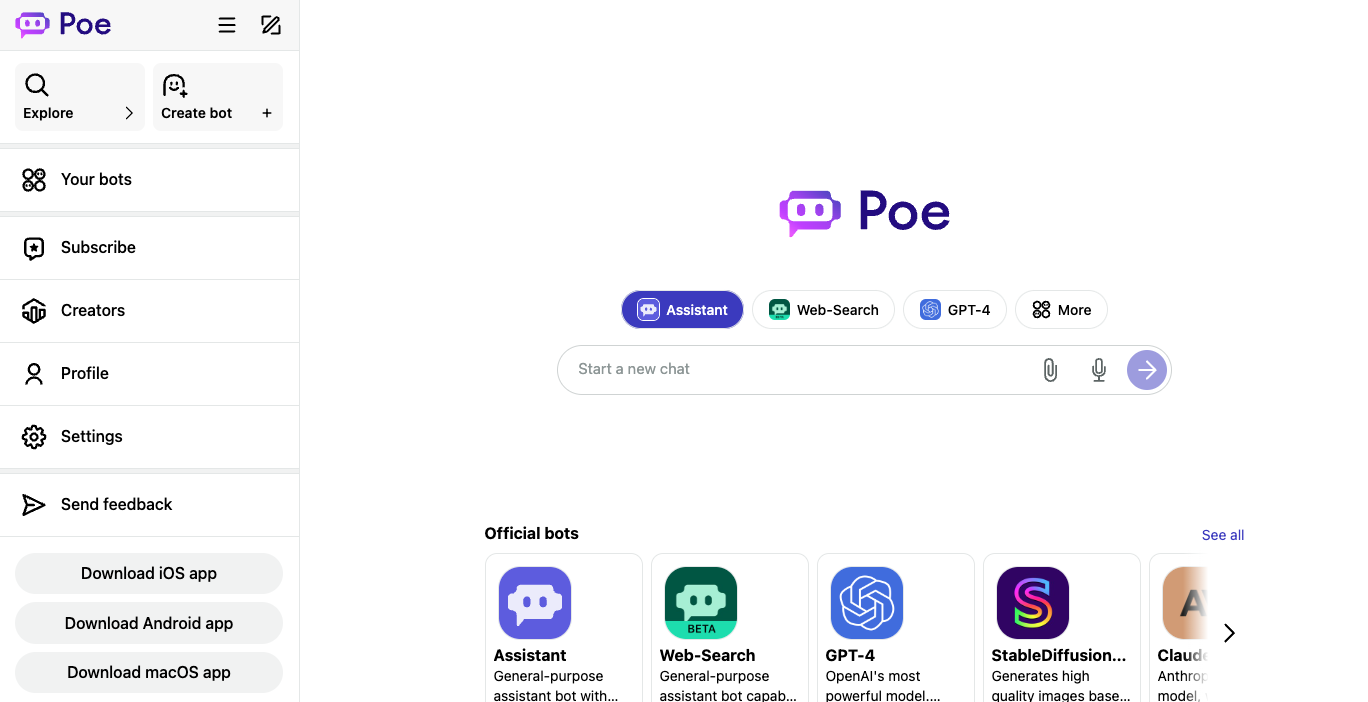
Poe lets you talk to ChatGPT, Claude, Gemini, Grok, Llama, and hundreds of community bots from a single account. That’s the appeal: try many models without juggling API keys or stacking subscriptions. The catch is that Poe is a layer over other providers, so quality, context length, and per-message cost vary by which bot you pick - and the points system takes getting used to if you’re coming from flat-rate chat plans.
Many models, one consumer app - compare GPT, Claude, Gemini, Grok, and community bots without API keys or stacked subscriptions.
The bot ecosystem goes beyond text chat - user-created bots, group chats up to 200 people, and multimodal Script Bots give range a single-provider app can’t.
The points system creates cost uncertainty - bots consume points at very different rates and heavy frontier use burns plans fast, so budget against usage.
Choose Poe if you want to compare frontier models without committing to one provider, or you’re not sure which you’ll prefer long-term. Skip it if you want one consistent assistant with predictable limits - ChatGPT or Claude work better.
If you want a strong default for everyday work → ChatGPTIf you live in Google apps and care about visuals → GeminiIf you write, code, or work with long documents → ClaudeIf you want a free or low-cost option → DeepSeekIf your work runs through Microsoft 365 → CopilotIf you cover X, social, or live trends → GrokIf you want to compare many models in one app → Poe
We evaluated more than 20 AI chatbots and selected 7 for this guide. We don’t use affiliate links, accept sponsorships, or take payment from tool makers. Recommendations are based entirely on our own evaluation and comparisons across writing, research, coding, image generation, and everyday questions, plus weeks of normal use as our daily drivers.
We ran each chatbot against a consistent set of prompts covering long-form writing, technical research, code generation, image creation, and structured analysis. We paid attention to whether output matched the prompt, whether claimed features actually worked, and where friction kept showing up. We also tracked which tools we kept coming back to after the formal comparison ended - that’s usually the most honest signal.
A few practical considerations matter more than tool choice. These are the security, legal, and privacy issues most likely to bite you in the first month.
Most major chatbots use your conversations to improve their models unless you turn that off, and the controls live in different places (settings, plan tier, or admin console). For sensitive business, legal, or medical content, check each tool’s data retention and training opt-out before pasting anything you wouldn’t want in a future model. Enterprise plans usually offer stronger guarantees than consumer tiers.
Not all chatbots offer the same data residency, content moderation, or regulatory posture. Microsoft and Google offer the strongest enterprise governance. Grok’s content posture is looser by design. Match the provider to your regulatory and trust requirements, not just to model quality.
Every chatbot in this guide still makes confident factual errors. The rate varies, but no model is reliable enough to trust without checking for legal contracts, medical advice, financial decisions, or anything where a wrong answer carries real cost. Tools with citations (Gemini Deep Research, Perplexity, ChatGPT Research) make verification easier but don’t eliminate the problem.
Customer-support AI chatbots (Intercom Fin, Zendesk AI, Chatbase): These deploy on websites or help centers to deflect support tickets. Choose this category when you need an AI agent on a business site, not a personal assistant.
Coding agents and AI IDEs (Cursor, Claude Code, GitHub Copilot): Their primary value is coding inside repos, IDEs, and pull-request workflows. Choose when you’re really there for code work - writing, editing, or reviewing - not everyday chat.
AI companion and roleplay chatbots (Character.AI, Replika, Kindroid): These optimize for personality, companionship, and roleplay rather than productivity. Choose when you want fictional characters or emotional companionship over a work assistant.
What's an AI chatbot, and how is it different from AI search?
AI chatbots are general-purpose assistants that handle writing, coding, research, file work, and conversation. AI search tools like Perplexity prioritize cited answers to specific web queries. The line blurs - ChatGPT and Gemini both search now - but chatbots are built for open-ended sessions, while search tools optimize for retrieval.
Can I use these chatbots if my company has a strict data policy?
Usually yes, but check the enterprise tier. ChatGPT Business, Claude Team/Enterprise, Microsoft 365 Copilot, and Gemini for Workspace all offer no-training-on-data guarantees, admin controls, and audit logs. Personal accounts and free tiers typically do not. Many companies block consumer chatbot domains entirely - confirm with your IT or security team first.
What happens to my chats and files if I cancel a subscription?
Most providers keep your account and history accessible on the free tier after a paid plan ends, but subscription features (longer context, projects, connectors) get disabled. Always export before canceling if your work history matters - Claude and ChatGPT both make this easy.
Can I switch between plans without losing my data?
Yes, on every chatbot in this guide. Upgrades and downgrades within the same provider keep your chats, projects, and memory intact. Switching providers doesn’t transfer history automatically, though Gemini and Claude added memory-import tools recently.
Do these chatbots work with my existing tools like Notion, Slack, or Gmail?
Most top-tier chatbots offer connectors now. ChatGPT integrates with Notion, Linear, Dropbox, and Box. Claude connects to Slack, Google Workspace, and Microsoft 365. Gemini works natively across Google apps. Connector availability often depends on your plan and admin settings, so confirm before assuming a workflow will work.
Should I pay for one chatbot or use a multi-model tool like Poe?
If you have a clear workflow, paying one provider is usually simpler. If you’re still figuring out which model fits your work, or you want occasional access to several frontier models without stacking subscriptions, Poe or TypingMind makes sense. If you use any single model heavily, you’ll usually end up subscribing direct.
We update this guide regularly as new tools launch and existing ones evolve. If you’re still unsure, ChatGPT is the safest starting point for most users. Questions or suggestions? Let us know.


 ChatGPT
 Google Gemini
 Claude
 DeepSeek
 Microsoft Copilot
 Grok
Grok Poe
Poe